
A peptide certificate of analysis is the document that shows what a laboratory actually measured in a specific batch: purity, identity, and test date. Knowing how to read a peptide certificate of analysis lets researchers verify a supplier’s claims before ordering. This guide walks through each section, from the HPLC chromatogram to the LC-MS mass result.
Careful reading matters because analytical data supports reproducible research. Moreover, a detailed peptide certificate of analysis shows whether a supplier applies real quality control or relies on general claims.
What Is a Peptide Certificate of Analysis?
A peptide certificate of analysis is issued by a qualified analytical laboratory. It confirms that a specific batch meets defined quality specifications. For research peptides, the laboratory generates it after testing the manufactured batch, not before, and not from theoretical calculations.
Importantly, the document is batch-specific. It applies only to the lot number printed on it. Therefore, a certificate from a previous batch does not confirm the quality of a new one, even when the compound name and supplier are identical. Always check that the lot number on the document matches the lot number on your vial.
Product Identification on a Peptide Certificate of Analysis
1. Product Identification
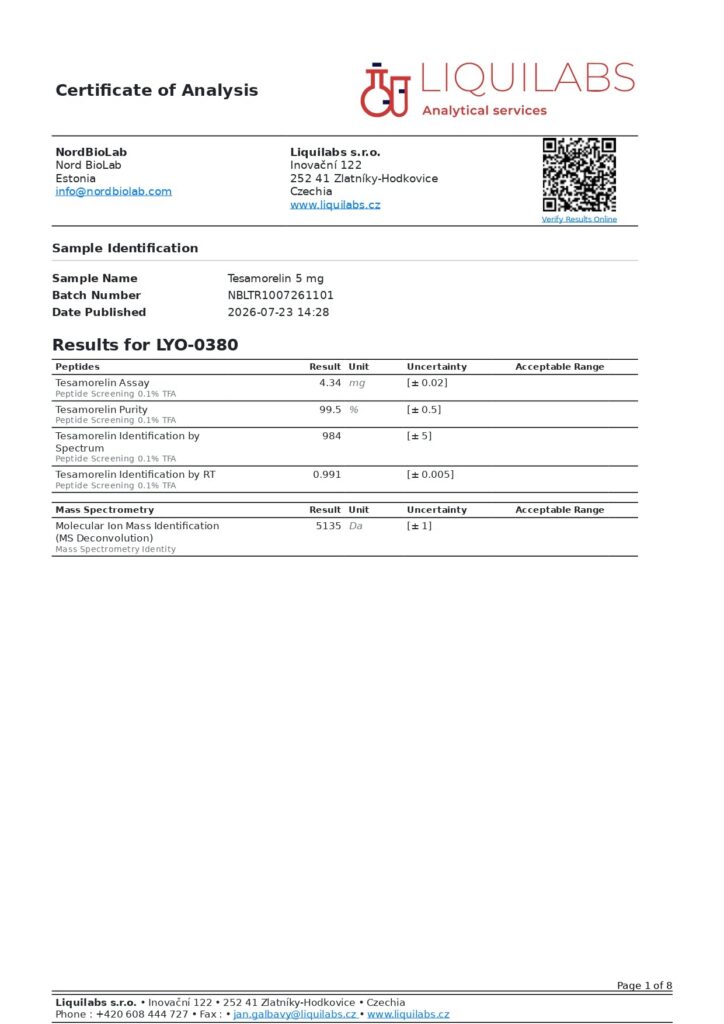
The first section lists the product name, catalog number, lot number, molecular formula, and molecular weight. For example, a BPC-157 certificate may show the formula C₆₂H₉₈N₁₆O₂₂ and a molecular weight of 1419.53 g/mol (example values).
Check three things in this section:
- The compound name matches your order.
- The molecular weight matches published literature values.
- The lot number matches the label on your vial.
Next, look at the appearance line. Lyophilized peptides normally appear as a white to off-white powder. However, discoloration, visible moisture, or clumping may indicate degradation or poor lyophilization. A mismatch in formula or weight is a red flag, because it may point to misidentification or contamination.
2. Appearance
What to check: Lyophilized peptides should appear as a white, off-white, or occasionally slightly yellow powder depending on the compound. Discoloration, visible moisture, or clumping may indicate degradation or improper lyophilization. This section confirms the batch was visually inspected.
3. HPLC Purity on a Peptide Certificate of Analysis (Most Important Section)
HHPLC purity is the most important result on a peptide certificate of analysis. High-performance liquid chromatography separates the target peptide from impurities and reports what share of the total peak area belongs to the target compound.
A typical entry lists the method (reverse-phase HPLC), the column (C18), the mobile phase (acetonitrile and 0.1% TFA in water), the detection wavelength (UV at 220 nm), the result (for example 98.7%), and the specification (≥ 98.0%). How to interpret the number:
- ≥ 98% is the benchmark commonly used for research-grade peptides.
- 95–97% may be acceptable for some applications, but it represents lower quality.
- Below 95% is generally not suitable for research use.
In addition, a chromatogram should accompany the result. It plots the detector signal against retention time, and a single dominant peak with small impurity peaks confirms the measurement.
4. LC-MS and Mass Spectrometry Identity Confirmation
Purity alone does not prove identity. Mass spectrometry closes that gap by measuring the mass-to-charge ratio of the compound. For peptides in this size range, ESI-MS is the standard method.
The certificate lists an expected [M+H]⁺ value and a found value. For example, an expected 1420.5 and a found 1420.6 is a pass. As a rule, the two values should agree within about 1–2 Da. A larger gap suggests incorrect synthesis, the wrong compound, or adduct formation.
Consequently, a peptide certificate of analysis with HPLC purity but no mass confirmation tells you that a pure compound was present, but not which one. Both analyses together confirm purity and identity.
5. Water Content and Net Peptide Content on a Peptide Certificate of Analysis
Lyophilized peptides retain residual water, so the certificate often reports Karl Fischer titration. For instance, a result of 5.2% against a specification of ≤ 10% is acceptable, while higher values may indicate incomplete lyophilization.
Furthermore, some certificates report net peptide content, measured by amino acid analysis. This value accounts for water, counterion salts (such as TFA or acetate), and other non-peptide mass. A vial labeled 5 mg with 84.3% net peptide content holds about 4.2 mg of actual peptide (5 × 0.843 = 4.215).
For precise work, use net peptide content instead of labeled weight when you calculate stock solution concentrations. This section does not appear on every certificate, so its presence signals a higher analytical standard.
6. Peptide Content / Net Peptide Content
What to check: This is a more sophisticated measurement than HPLC purity. It accounts for water content, counterion salts (such as TFA or acetate from synthesis), and other non-peptide mass in the vial. The net peptide content represents the actual mass of peptide per labeled weight.
- A vial labeled 5mg with 84% net peptide content contains approximately 4.2mg of actual peptide
- This section is not present on all peptide Certificate of Analysis — its inclusion indicates a higher quality analytical standard
- For accurate experimental dosing, use net peptide content rather than labeled weight when available
7. Sterility and Endotoxin (When Present)
Not every peptide certificate of analysis includes endotoxin or sterility results. However, they matter for cell culture and other sensitive experimental systems. A typical entry reads: endotoxin < 1 EU/mg (LAL method), sterility passed (USP <71>).
Endotoxin levels above 1 EU/mg can activate inflammatory pathways in cell-based assays and produce false results. Therefore, if your work involves cell culture, request endotoxin data specifically. Sterility testing, in turn, confirms the absence of microbial contamination.
Red Flags: What a Poor Certificate of Analysis Looks Like
Some documents look official but lack the data that makes them meaningful. Watch for the following warning signs:
| WARNING SIGN | WHAT IT MAY INDICATE |
|---|---|
| No lot number or generic lot number | COA not batch-specific; potentially fabricated |
| HPLC purity below 98% | Lower quality compound |
| No MS confirmation | Identity not independently verified |
| No testing laboratory name | Tests may not have been performed |
| COA date predates your order by years | Old COA applied to new batch |
| Purity listed as “99.9%” with no chromatogram | Suspiciously round figures without supporting data |
| No specification column | No defined quality standard was applied |
Conclusion: Verify Every Peptide Certificate of Analysis Before You Order
In short, a reliable peptide certificate of analysis names the testing laboratory, shows a batch-specific lot number, reports HPLC purity with a chromatogram, and confirms identity by mass spectrometry. Additional data such as water content, net peptide content, and endotoxin levels add further confidence.
Finally, compare the lot number on the document with your vial, and read every section before you rely on the data. NordBioLab publishes batch-specific certificates for its research compounds, so you can browse the CoA library and check the results yourself.

Leave a Reply