
Category: Testing & Quality | Reading time: 7 min | For research use only
A peptide Certificate of Analysis, or COA, summarizes analytical results for a defined batch of material.
For research peptides, a useful COA can help researchers assess several different questions:
- Is the material identified as the expected peptide?
- What does the chromatographic purity result show?
- Was peptide content or assay measured separately?
- Which analytical methods were used?
- Does the certificate correspond to the batch being supplied?
Reading a COA correctly is important because no single number — including a high HPLC purity percentage — tells the complete analytical story.
This guide explains the main sections commonly found on peptide COAs and how to interpret them.
What Is a Peptide Certificate of Analysis?
A Certificate of Analysis is a document reporting test results for a specified material or batch against defined analytical parameters or specifications.
Depending on the quality system, testing may be performed by:
- the manufacturer’s own quality-control laboratory;
- an independent third-party analytical laboratory;
- or a combination of internal and external laboratories.
A COA therefore does not need to come from a third-party laboratory to be legitimate.
What matters is whether the document clearly identifies the material, batch, analytical methods, results, and source of the testing.
For research peptides, batch-specific documentation is especially useful because analytical results obtained for one lot should not automatically be assumed to represent another.
First check: the batch number
Before examining any purity number, compare the batch or lot identifier on the COA with the identifier supplied with the material.
A COA from another lot may provide useful background information, but it does not constitute analytical evidence for the batch being evaluated.
1. Product and Batch Identification
The first section of a peptide COA normally identifies the material being tested.
Depending on the laboratory and report format, this may include:
- peptide name;
- sequence;
- lot or batch number;
- sample or laboratory reference number;
- molecular formula;
- calculated molecular mass;
- test date;
- manufacturing or release information;
- storage information.
Not every COA contains every one of these fields.
What should you check?
Confirm that:
- the peptide name corresponds to the material ordered;
- the batch or lot number corresponds to the supplied batch;
- the expected molecular characteristics are consistent with the peptide structure;
- any listed modifications — such as acetylation, amidation, D-amino acids, or conjugates — are correctly represented.
For modified peptides, these details can materially affect the expected molecular mass.
Example of a Batch-Specific COA
The image below can be used as an example of the type of analytical documentation researchers may encounter.
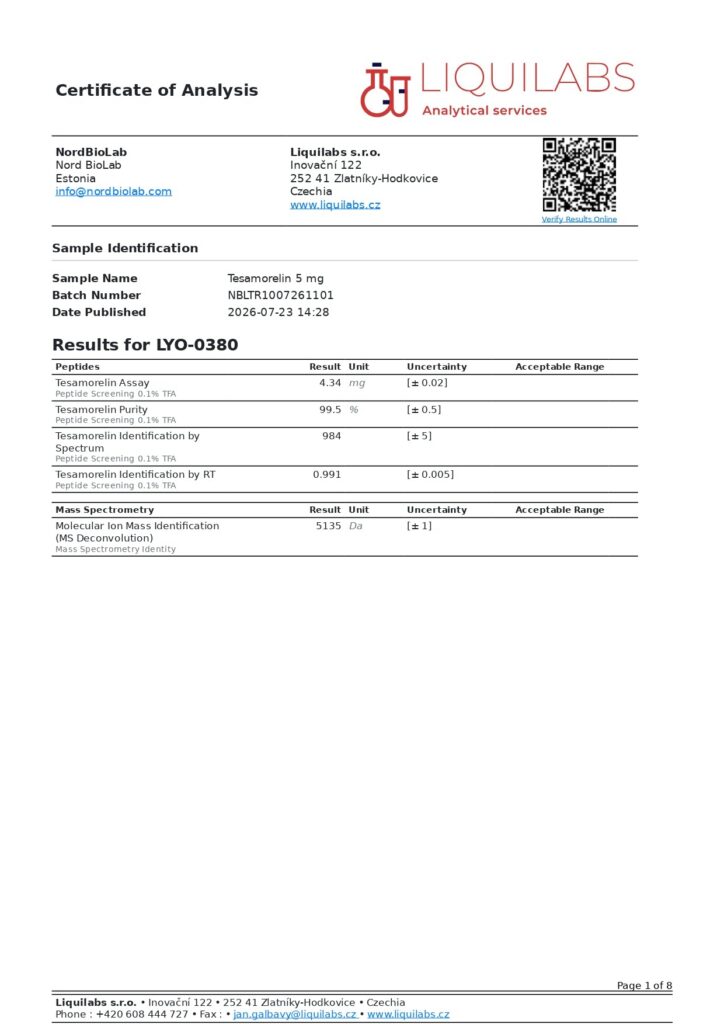
Example of a batch-specific peptide Certificate of Analysis showing analytical results for a defined research batch.
2. Appearance
Some COAs include a visual description of the material.
Typical descriptions may include:
- white lyophilized material;
- off-white lyophilized material;
- powder;
- cake or solid material.
Appearance can be useful as a basic quality-control observation, but it should not be overinterpreted.
Different peptides and formulations can vary in:
- color;
- cake structure;
- density;
- position within the vial;
- degree of cracking or collapse.
A lyophilized peptide attached to the side of a vial, for example, is not automatically damaged.
Likewise, visual appearance alone cannot establish peptide identity, purity, or content.
For more information, see:
- Why Doesn’t Every Lyophilized Peptide Cake Look the Same?
- The Lyophilized Peptide Is Attached to the Side of the Vial. Is It Damaged?
3. HPLC Purity
HPLC — high-performance liquid chromatography — is commonly used to evaluate chromatographic purity.
For synthetic peptides, reverse-phase HPLC is frequently used to separate the principal peptide peak from related peptide impurities.
A report may include:
- chromatographic method;
- column type;
- detection wavelength;
- retention time;
- main-peak area;
- calculated purity;
- specification;
- chromatogram.
What does an HPLC purity result mean?
If a report states:
HPLC purity: 98.7%
this generally means that the main peptide-related chromatographic peak accounted for approximately 98.7% of the integrated signal under the specified analytical conditions.
It does not mean that 98.7% of the total vial mass is necessarily the desired peptide.
HPLC purity generally does not account for non-peptide components such as:
- water;
- counterions;
- residual salts;
- some residual solvents;
- excipients, where present.
This distinction is fundamental when interpreting peptide COAs.
Is 98% the universal standard?
No.
There is no single purity percentage that is universally appropriate for every research application.
Purity requirements depend on factors such as:
- intended experiment;
- sensitivity of the assay;
- peptide complexity;
- impurity profile;
- analytical method;
- laboratory requirements.
Commercial research peptides are often offered at specifications such as ≥95%, ≥98%, or ≥99%, but these are supplier or application specifications rather than universal scientific thresholds.
4. Should a Chromatogram Be Included?
A chromatogram provides useful supporting information because it shows the separation and relative detector response underlying the reported HPLC result.
It can help researchers evaluate:
- whether there is one dominant peak;
- whether significant secondary peaks are present;
- retention time;
- integration of the main peak and impurities.
However, a chromatogram does not always appear directly on the COA itself.
Some laboratories provide:
- a summary COA;
- a separate HPLC report;
- raw chromatographic data;
- or an analytical report containing the chromatogram.
Therefore, the absence of a chromatogram on the certificate itself does not automatically invalidate the COA.
Where analytical transparency is important, researchers can request the underlying chromatographic report.
5. LC-MS and Identity Confirmation
HPLC purity and peptide identity answer different questions.
A chromatogram may show that a sample contains one dominant component, but chromatographic purity alone does not prove that the dominant component is the expected peptide.
Mass spectrometry provides additional identity information by measuring mass-to-charge ratios associated with the analyte.
For peptide analysis, methods may include:
- LC-MS;
- ESI-MS;
- high-resolution MS;
- LC-MS/MS.
LC-MS/MS can provide further structural information and can be used to support peptide sequence confirmation. USP references LC-MS/MS among the analytical approaches used to establish peptide identity.
What should you compare?
The report may show:
- calculated molecular mass;
- observed molecular mass;
- expected and observed ions;
- multiple charge states;
- deconvoluted mass;
- mass accuracy.
Peptides commonly form multiply charged ions, so the spectrum may contain peaks such as:
[M+2H]²⁺, [M+3H]³⁺, or higher charge states rather than only [M+H]⁺.
Is a difference of 1–2 Da always acceptable?
No.
Acceptable mass tolerance depends on the analytical instrument and method.
Low-resolution instruments may report mass differences in daltons, while high-resolution systems commonly evaluate mass accuracy in parts per million (ppm).
For example, high-resolution synthetic-peptide workflows may use tolerances around 10 ppm, while different instruments and methods may use other criteria.
Researchers should therefore evaluate the result against the method’s stated acceptance criteria, not against a universal 1–2 Da rule.
6. HPLC Purity Is Not Peptide Content
This is one of the most important distinctions when reading a peptide COA.
Consider a lyophilized sample containing:
- target peptide;
- peptide-related impurities;
- water;
- counterions;
- salts;
- residual process components.
HPLC may measure how much of the peptide-related chromatographic signal corresponds to the desired sequence.
It does not necessarily tell you how much of the total dry material is peptide.
Industry technical guidance therefore distinguishes between peptide purity and peptide content.
7. Peptide Content, Assay and Net Peptide Content
Some analytical reports include a separate quantitative measurement of peptide content.
This may be reported as:
- peptide content;
- net peptide content;
- assay;
- quantitative amino acid analysis;
- or another validated quantitative method.
Quantitative amino acid analysis, or AAA, is one established approach used in peptide quantitation.
Why can peptide content be lower than HPLC purity?
Because lyophilized peptide material can also contain:
- residual water;
- counterions such as acetate or TFA;
- salts;
- residual solvents;
- non-peptide components.
For example, a material could theoretically show:
HPLC purity: 99%
Peptide content: 84%
These results are not contradictory.
They describe different characteristics of the material.
The first describes chromatographic purity among detected peptide-related components.
The second addresses how much peptide is present relative to the overall sample mass.
For a deeper explanation, see:
99% HPLC Purity Does Not Mean 99% Peptide Content
8. Water Content
Residual water may be measured using methods such as Karl Fischer titration.
Water content can be relevant because lyophilized products are not necessarily completely water-free.
A COA may therefore report:
- measured water content;
- specification;
- analytical method.
There is no universal acceptable water percentage for every synthetic peptide.
The appropriate specification depends on the product, formulation, manufacturing process, stability requirements, and intended analytical standard.
Water results should therefore be assessed against the specification defined for that material rather than against a universal cutoff.
9. Counterions
Synthetic peptides are often isolated as salts.
Common counterions include:
- trifluoroacetate (TFA);
- acetate;
- chloride.
Counterion content contributes to total sample mass and can therefore affect the relationship between gross weight and actual peptide content.
Some more comprehensive analytical packages measure counterions separately.
This can be particularly useful where accurate mass balance or quantitative peptide content is important.
10. Endotoxin Testing
Endotoxin testing may be important for certain experimental applications, particularly biological systems that can respond strongly to bacterial endotoxins.
A peptide contaminated with endotoxin could potentially affect inflammatory or immune-related readouts independently of the peptide itself.
However, there is no single universal endotoxin limit such as <1 EU/mg that is appropriate for every research experiment.
Acceptable endotoxin exposure depends on factors including:
- experimental system;
- concentration of peptide used;
- cell type;
- assay sensitivity;
- route and context of experimental exposure;
- laboratory protocol.
Researchers working with endotoxin-sensitive systems should therefore define an appropriate endotoxin specification for their particular experiment.
11. Sterility Testing
Sterility and endotoxin are separate quality attributes.
Sterility testing evaluates the presence or absence of viable microorganisms under defined test conditions.
It may be relevant for some experimental systems but is not a universal requirement for every laboratory peptide application.
Likewise, a research peptide should not be assumed to be sterile simply because it is supplied in a sealed vial.
If sterility is required for an experimental protocol, researchers should verify that appropriate testing has actually been performed.
12. What Makes a COA More Informative?
Rather than looking for one particular number, assess the analytical package as a whole.
A useful peptide COA or supporting analytical report may provide:
| Information | What it helps establish |
|---|---|
| Peptide name and sequence | Material identification |
| Batch/lot number | Traceability |
| HPLC result | Chromatographic purity |
| Chromatogram | Supporting separation data |
| LC-MS / MS result | Molecular identity |
| Peptide content / assay | Quantitative peptide amount |
| Water content | Residual moisture |
| Counterion analysis | Non-peptide mass contribution |
| Endotoxin testing | Relevant contamination control |
| Test date | Analytical traceability |
| Laboratory/report reference | Source of analytical data |
Not every legitimate COA will contain every item.
The appropriate analytical package depends on the peptide and the intended research application.
Red Flags When Reviewing a Peptide COA
Some warning signs deserve closer investigation.
| Warning sign | Why it matters |
|---|---|
| No batch or lot identifier | Cannot reliably link the data to supplied material |
| Batch on COA does not match supplied batch | Results may refer to different material |
| Purity shown without an analytical method | Difficult to understand what was measured |
| Identity claimed without supporting identity test | Purity alone does not establish identity |
| Molecular data inconsistent with the stated peptide | May indicate documentation or identification problems |
| Identical analytical reports repeatedly used for different batches | May indicate non-batch-specific documentation |
| Implausibly precise claims without supporting analytical data | Requires verification |
| Test date or sample information inconsistent with batch history | Traceability should be investigated |
| Missing source or report identification | Makes independent verification more difficult |
One point is important: the absence of a third-party laboratory name is not automatically a red flag. A manufacturer may legitimately perform its own QC testing.
The key question is whether the source of the analytical result is identifiable and the data can be traced to the batch.
Why Batch-Specific COAs Matter
A generic certificate can describe a peptide specification, but it cannot demonstrate what was measured in every subsequent production batch.
Each synthesis and purification run can differ.
Batch-specific testing therefore provides more useful information about the actual material being supplied.
For a detailed discussion, see:
Why a Batch-Specific COA Matters More Than a Generic Certificate
How NordBioLab Presents Analytical Documentation
NordBioLab provides batch-specific analytical documentation for applicable research products.
Depending on the product and batch, available analytical data may include:
- HPLC purity;
- LC-MS identity confirmation;
- assay or content information;
- batch identification;
- additional analytical results where performed.
Rather than relying on a single purity percentage, researchers should review the available analytical package for the specific batch.
Browse NordBioLab batch-specific Certificates of Analysis →
This CTA should link to the NordBioLab COA / Quality page rather than to one individual product.
Individual product pages can additionally link directly to the analytical documentation available for the current batch.
Conclusion
A peptide Certificate of Analysis should be read as a collection of analytical results rather than as a single purity number.
The most useful questions are:
Does the certificate match the batch?
Was the peptide identity confirmed?
What exactly does the HPLC result measure?
Was peptide content or assay measured separately?
Are the analytical methods and results traceable?
HPLC, LC-MS, peptide-content analysis, water determination, counterion analysis, and endotoxin testing answer different questions.
Understanding those differences makes it easier to evaluate research materials appropriately and to avoid one of the most common mistakes in peptide analysis:
assuming that “99% HPLC purity” means “99% peptide by vial weight.”
All NordBioLab products are intended exclusively for scientific and laboratory research. They are not intended for human or veterinary use. Information provided on this page is for educational and research purposes only.

Leave a Reply